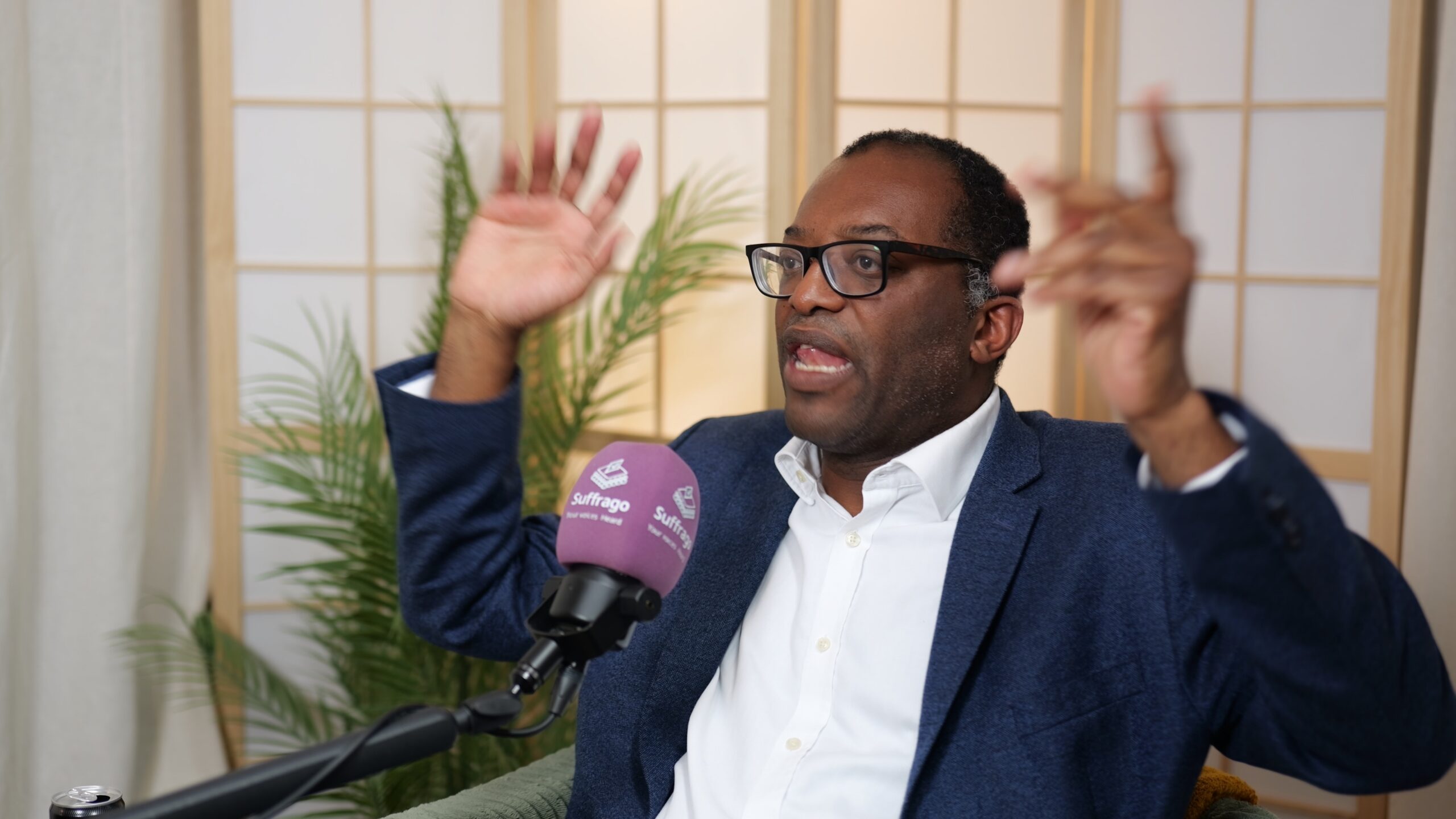


(Photos from the Suffrago-sponsored Conversation Cabinet podcast – main image of Kwasi Kwarteng)
Every day, millions – perhaps billions – of opinions are expressed. They appear in elections, opinion polls, newspaper comments, WhatsApp groups, public consultations, conversations between neighbours and arguments on social media. They influence governments, businesses, charities, schools, hospitals and families. They shape almost every collective decision we make (including in Quaker Meetings!).
 Will Stone, Labour MP.
Yet despite the importance of opinion, there is remarkably little agreement about how opinions themselves should be studied.
Political science (my background) examines governments, institutions and elections. Economics studies incentives, markets and the allocation of resources. Psychology explores the mind, of course, while sociology considers groups and societies. Polling measures what a sample of people say they think at a particular moment. Each of these disciplines tells us something important, but none places opinion itself at the centre.
That is the gap we have begun to explore at Suffrago, with my founder hat on, and we have started using a word to describe it: Opinionomics.
 Lord Dominic Johnson.
We use the term cautiously. We are not claiming to have founded a new academic discipline – yet – but my hope is that it becomes its own field. Opinionomics is, for now, an emerging concept. It draws upon political science, economics, psychology, sociology, statistics, philosophy, data science and artificial intelligence. Our suggestion is simply that opinion is sufficiently important, and sufficiently distinct, that it deserves to be studied more directly and more systematically than it is today.
Opinionomics is concerned not only with what people think, but why they think it. It examines how opinions relate to one another, how they are distributed between different groups, how firmly they are held, how they change over time, how they interact with evidence and how they evolve when the evidence changes. It also asks how opinions influence decisions, and how decisions, institutions and events go on to reshape opinion in return.
 Jimmy McLoughlin OBE from Jimmy’s Jobs of the Future.
Polling provides perhaps the clearest illustration of the distinction. A poll may tell us that 58 per cent of people oppose a proposal. That is valuable information, but it is only the beginning. Why do they oppose it? Do they reject the objective itself, or merely the proposed method? Are different groups reaching the same conclusion for entirely different reasons? What facts are they relying upon, and do they even agree on those facts? Are objections driven by practical experience, distrust, identity, cost or perceived unfairness? Could an alternative proposal command a much broader consensus? The percentage matters, but the structure beneath the percentage may matter even more.
Opinionomics is therefore not an alternative to polling. Polling is one of its essential tools. The difference is that Opinionomics seeks to understand more fully what those answers mean, what lies behind them and how they connect with evidence, behaviour and future decision-making.
Nor is Opinionomics simply another name for politics! Opinions are not confined to elections, parties or governments. Employers need to understand the views of their workforce. Universities seek the views of students. Businesses want to understand customers. Local authorities consult residents. Charities ask communities what matters to them. Families negotiate priorities and make decisions together. Religious groups seek unity around difficult questions. Opinion is woven through almost every part of collective human life.
Opinionomics is also distinct from economics. Economics has transformed our understanding of incentives, trade-offs and choice, but people are not motivated solely by income, price or utility. They care about fairness, trust, dignity, identity, belonging, security, status, faith, loyalty and principle. These forces shape both what people believe and how they behave, often in ways that conventional economic models struggle to explain.
Perhaps the most distinctive feature of Opinionomics, however, is its relationship with evidence. Public opinion matters, but it is not automatically correct. Evidence matters too, but evidence does not interpret itself, determine priorities or remove legitimate disagreements about values. Opinion based without evidence can be noise, manipulation or collective error. Evidence without public opinion can become technocracy. Better decisions require both, I think.
At Suffrago, we are exploring how structured public participation, trusted data, expert knowledge, lived experience and artificial intelligence might be brought together. The objective is not simply to discover what people think, but to understand why they think it, where different perspectives overlap, where they diverge from the available evidence and whether better information changes people’s judgement over time. This is a more ambitious task than measuring opinion. It is an attempt to understand its structure, its formation, its movement and its consequences.
Underlying all of this is a simple observation. Every person sees only part of reality. The same is true of every institution, every dataset, every expert, every journalist, every government and every artificial intelligence system. Each sees the world through its own information, experience, incentives and limitations. Better decisions become possible when those partial perspectives are brought together honestly, tested against evidence and made easier to understand.
Whether Opinionomics ultimately becomes an accepted field of study is not for Suffrago – or me – to decide. This will depend on whether researchers, organisations and communities find the concept useful; whether they challenge it, improve it and apply it to problems we have not yet imagined. That is, I think, how serious fields develop: not because somebody, like me, announces that they exist, but because they produce ideas, methods and findings that other people find valuable.
I hope Opinionomics proves useful – improving understanding and decisions. If it encourages better questions, better research and better decisions, then it will have served its purpose. Like every worthwhile idea, its success will ultimately be measured not by the name we have given it, but by whether other people find it valuable enough to build upon.
Time will tell.
Andrew Gray July 2026